

The tragic death of Princess Sissi and the forensic investigations into her case in a piece by our Mirella Gherardi

The Beloved Empress Elisabeth of Austria
Elisabeth Amalie Eugenie, Duchess of Bavaria, born on December 24, 1837, known to the world simply as Sissi, is one of the most beloved historical figures among the general public. Her image is inseparably linked to the face of the beautiful Romy Schneider, who portrayed her in the famous films of the 1950s.

Beyond the romantic tale that sees her, on April 24, 1854, as the young bride of Emperor Franz Joseph of Austria, Sissi’s life is marked by restlessness and deep sorrow. Rebellious against the strict rules of court life, which she never manages to accept, the Empress is deeply scarred by the loss of two of her four children. After the death in 1857 of little Sophie, only two years old, comes the tragic death of her son Rudolf, who takes his own life on January 30, 1889, in Mayerling. Her own end, which would come less than ten years later, would be equally dramatic.

The Assassination in Geneva
On September 10, 1898, at the age of 60, Sissi is assassinated in Geneva by the Italian anarchist Luigi Lucheni. Few people know that a post-mortem examination and an autopsy were performed on the Empress. The official reports from these procedures are fully preserved and analyzed in detail in a scientific article that has allowed a better understanding of the nature of her fatal wound.
That afternoon, around 1:00 p.m., the Empress is walking along the Quai de Mont Blanc on the shores of Lake Geneva, accompanied by her lady-in-waiting, the Hungarian Countess Irma Sztáray. Sheltering under an umbrella, the two women are heading toward the pier where a steamboat awaits them. Just a few steps from boarding, a man suddenly lunges at them. No one sees a weapon, no gunshots are heard. Witnesses initially believe it to be an attempted robbery. The Empress herself, confused, asks her companion: “What do you think that man wanted from me? Perhaps my watch?”
Meanwhile, the steamboat’s bell signals its imminent departure. The two women hurry to board, but just minutes after leaving the dock, Sissi suddenly grabs her companion’s arm. Her face turns pale, and the Empress collapses, losing consciousness. Informed of the incident, the boat’s captain orders an immediate return to the port. The Empress briefly regains consciousness and finds the strength to utter her final words: “What has really happened to me?”
The Doctors’ Intervention on the Empress
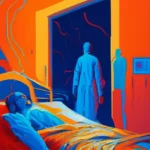
Upon reaching the shore, six sailors carry Sissi’s lifeless body to room number 34 of the Hotel Beau-Rivage, where, within minutes, two doctors arrive—Dr. Golay and Dr. Mayor—followed by a priest. The Empress is laid on the bed. Her lady-in-waiting and the hotel manager’s wife begin undressing her, and at that moment, they believe they detect a faint breath. But what strikes them, after removing the tight corset, is a dark stain, about the size of a coin, appearing on Sissi’s undergarment.
There is nothing the doctors can do but confirm her death. In the immediate aftermath, there is not yet time for rigor mortis or post-mortem lividity to develop. The doctors check for reflexes using a small hammer and verify the absence of blood circulation by performing a phlebotomy.
As a result of these procedures—which from today’s perspective may raise some questions—the death of the Empress of Austria is officially declared at 2:10 p.m.
To be continued…