

The tragic death of Princess Sissi and the forensic investigations into her case in a piece by our Mirella Gherardi
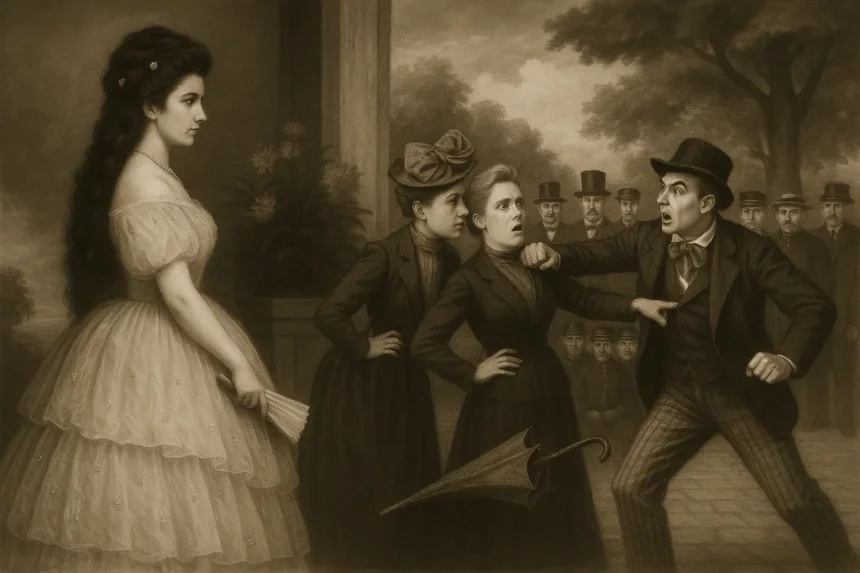
Continuing the story of the murder of Empress Elisabeth of Austria (Sissi), we now focus on the police and forensic investigations that followed her attack, while also outlining the personality of her assassin, the Italian anarchist Luigi Lucheni.
The External Examination
At 4:00 p.m. on September 10, 1898, the Investigating Judge of the Republic of the Canton of Geneva tasked Dr. L. Mégevand to “…draw up a medical report on the death of Her Majesty the Empress of Austria; to determine the cause of death and, if necessary, to perform an autopsy in agreement with the heir or heirs of the Empress…”.
At 5:00 p.m., when Dr. Mégevand performed the external examination, rigor mortis was not yet apparent, although some livor mortis was visible in dependent areas.
Traces of Medical Intervention
On the body, traces of the maneuvers performed by Drs. Golay and Mayor to ascertain the Empress’s death are still visible: around the nipple, superficial lesions caused by the reflex hammer can be observed, while on the right wrist a post-mortem incision is described, performed to carry out a bloodletting. There is, however, no mention of the alleged presence of a small anchor tattoo that — according to some stories — Sissi had on her left shoulder as a tribute to the sea she so loved.
Description of the Wound
At this point, the forensic physician focused on describing a small chest wound that was only revealed after removing the Empress’s undergarment.
Mégevand describes it as follows:
“…On the anterior and lateral left chest wall there is a V-shaped wound, located 11 cm below the left clavicle and 11 cm to the left of the sternal midline, 4 cm above the nipple. The wound opening is directed upward and outward. The upper, vertical branch measures 1 cm in length and 2 mm in width; the lower, almost horizontal branch measures 1.2 cm with a width of 4 mm. The wound appears dry and brownish, surrounded by a small bluish hemorrhagic halo a few millimeters wide…”.
The type and location of the wound, along with the Empress’s clinical condition, suggest a fatal injury caused by a penetrating object. However, the exact circumstances could only be clarified by an autopsy.
In truth, Emperor Franz Joseph I did not wish for an autopsy to be performed on his wife, but he felt it was appropriate to proceed according to local laws and therefore did not object.
On September 11, the Investigating Judge appointed a team of three professors from the University of Geneva to conduct the autopsy: Hippolyte Jean Gosse, professor of forensic medicine; Auguste Reverdin, professor of general surgery; and Louis Mégevand, the forensic pathologist. Their task was to definitively determine the cause of death.
The Autopsy
The autopsy was performed at 2:30 p.m. that same day “…in the presence of Countess Sztáray, lady-in-waiting, Count Kufstein, Austrian consul in Bern, General Berzeviczy, imperial delegate, Attorney General Navazza, and Doctors Mayor and Golay, who had attended to the Empress...”.
Upon opening the chest, the Swiss doctors noted, in the anterior left thoracic region, a penetrating wound through the third intercostal space with a fracture of the fourth rib, a through-and-through perforation of the left lung, laceration of the pericardium, and a triangular-section wound traversing the left ventricle with an entry point on the front and an exit on the back. These injuries, taken together, described the intracorporeal path of a single narrow wound 8.5 cm in length.
“It is concluded that the injuries were caused by a long, triangular instrument with relatively blunt edges, which pierced the thoracic wall with force, fractured a rib, and passed through the left ventricle.”
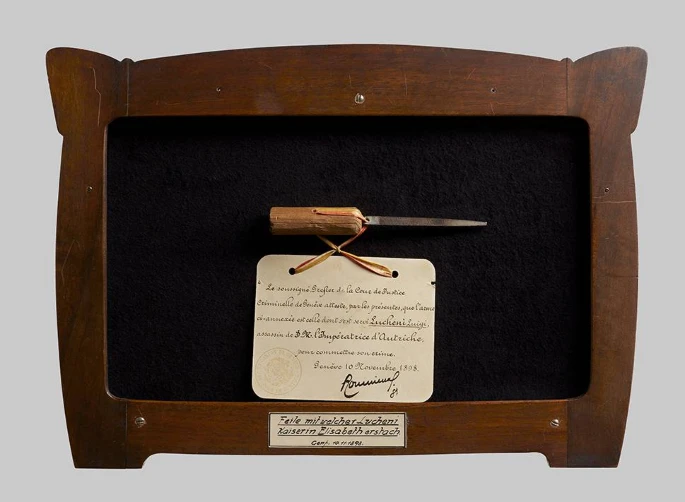
Indeed, the characteristics of the wound match those of a file later found in Luigi Lucheni’s possession, measuring 10 cm. The assassin later stated that he had struck with force, feeling the instrument penetrate deeply into the chest.
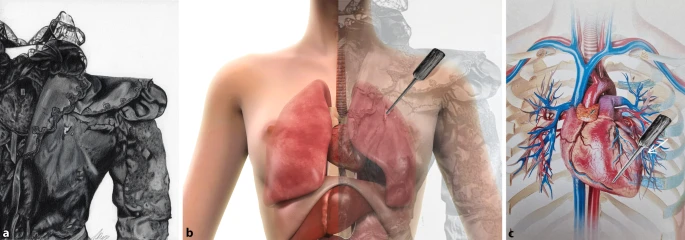
Yet the heart wound thus inflicted was narrow and clean, allowing only small amounts of blood to escape with each heartbeat. The blood gradually accumulated in the pericardial sac, progressively compressing the heart while arterial pressure dropped. This explains how, after being stabbed, Sissi was still able to stand up and even run to the boat before collapsing and losing consciousness.
Although the details of the wound were fully reconstructed, several questions remain.
The Assassin: Luigi Lucheni
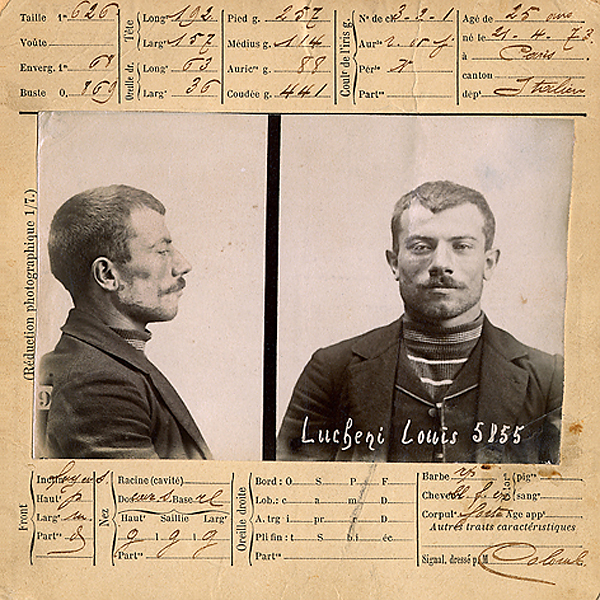
First of all, who was Lucheni, and why did he kill the Empress of Austria?
Luigi Lucheni was a laborer who had moved to Lausanne to work on the construction site of the new post office. There, he came into contact with anarchist circles focused on the idea of committing regicide as a symbolic political act. Lucheni decided he wanted to carry out an extreme act to give meaning to his life.
Lacking the funds to buy a proper weapon, he managed to acquire a file and had it sharpened. He traveled to Évian-les-Bains, a resort for the European aristocracy, and obtained the Evian Programme — later found in his pocket — to look for suitable high-profile targets. However, Lucheni failed to find a fitting victim and returned to Lausanne, hoping to strike the Duke of Orléans, but the nobleman had already departed. Just as he was about to abandon his plan, Lucheni met a former soldier who told him that the Empress of Austria was staying incognito at the Hotel Beau-Rivage.
Learning that the Empress planned to board a boat to Montreux, Lucheni waited at the Quai du Mont-Blanc, hiding behind a horse chestnut tree with the file concealed in a bouquet of flowers. As the Empress passed, he struck her with a single stab to the chest and attempted to flee. He was quickly apprehended by bystanders and handed over to the police. When asked about his motive, he declared:
“Because I am an anarchist. Because I am poor. Because I love workers and want the death of the rich.”
A Blow Struck with Surgical Precision
What is most striking is the almost surgical precision of the attack. How could Lucheni, with no medical training, deliver such a lethal blow, striking the heart? It’s unlikely that in just a few seconds — with the victim dressed in black, partially covered by an umbrella and a veil — the attacker could aim so precisely. It’s more plausible that he acted instinctively, with a blind but fatal blow.
Several questions remain:
If the file had not been immediately removed, might the Empress have survived longer?
Did her tight corset play any role in how the wound evolved?
Could Sissi have survived if the event had been managed differently?
As stated, Empress Elisabeth died from a penetrating chest wound involving the heart, caused by a narrow file — a very rare weapon in such cases. Although the instrument was unusual, cardiac injuries from thin, pointed objects like this are well documented and often fatal, even today. However, modern cases of survival are associated with immediate medical intervention.
Even at the time, the clinical signs of cardiac tamponade were known and pericardiocentesis was practiced, but it’s important to remember that survival in such cases relies on rapid first aid — something unthinkable in 1898 and unavailable to Sissi.
Moreover, there’s no strong medical basis to believe that leaving the file in place — acting like a “plug” — would have significantly increased her chances of survival. Likewise, no physiological evidence supports the idea that the tight compression of her chest by the corset played any meaningful role in the outcome of her injury.
A Death Shaped by Its Time
Finally, regarding the Empress’s health, there is no evidence that any pre-existing condition contributed to her death. Court records contain references to various preparations (ointments, tinctures, elixirs) suggesting psychosomatic ailments, with no connection to her violent demise. Elisabeth adhered to a strict beauty regimen: she maintained a 50 cm waistline through tight corsets and prolonged fasting, compensated by physical exercise and medical treatments. A mild form of rheumatism and a tendency toward “melancholy” — often interpreted as depression — are also documented, for which she was treated with cocaine, then considered a modern remedy.
In conclusion, the death of Empress Elisabeth of Austria was not only the result of a brutal act, but also a reflection of an entire era — a time when the idealized image of a sovereign collided with her genuine physical and emotional fragility, and when medicine — despite its progress — remained powerless in the face of a traumatic event handled with inadequate means. A story that, even today, invites us to critically reflect not only on the protagonists of history but also on the tools we use to reconstruct the truth.